Why owners search for the best business valuation tool for small business owners
If you are searching for the best business valuation tool for small business owners, you are usually facing one of four moments: a buyer is at the door, a partner is leaving, a banker wants a number, or a quiet decision has crept up on you and you can no longer make it without knowing what your business is worth. Whatever brought you here, the wrong tool wastes weeks. The right tool gives you a defensible range in one sitting and then lets you move levers to see what changes.
Most online "valuation calculators" hand you a single number that ignores half of what actually drives value. Most appraisers hand you a heavy report 6 weeks later. Neither helps you make the decision in front of you today. This guide walks through what to look for, how the institutional method works in plain English, and where XIT Matters fits when you compare it against the alternatives.
The three lenses every serious valuation tool must combine
Professional valuators do not rely on a single number. They triangulate, running three independent methods and looking for the range where the answers converge. If a tool gives you only one number, it is hiding most of the picture from you.
FCFF intrinsic value
Free Cash Flow to the Firm projects the cash your operations generate, discounts every dollar back to today using your weighted average cost of capital, adds a Gordon-growth terminal value, and applies an illiquidity discount calibrated for SMBs. The output is the enterprise value — what the whole business is worth to all the capital providers, lenders and owners alike. The strength of FCFF is rigor: every input is auditable, and the result is the closest thing to first-principles truth you can get.
FCFE equity value
Free Cash Flow to Equity is the same kind of math, but it strips out debt service first and uses a cost of equity instead of a blended WACC. The output is what your shares are worth — the number that matters when you are raising capital, modeling dilution, or deciding what to take home. Owners who confuse enterprise value with equity value end up giving away too much in a recap or accepting an undermarket buyout. FCFE keeps that distinction sharp.
EV/EBITDA market comps
Multiples are the language brokers, M&A advisors, and PE buyers actually speak. EV/EBITDA takes your trailing or forward EBITDA and multiplies it by what businesses like yours have transacted at. The risk is treating a multiple like a fact instead of a band. The best tool tells you the low, the median, and the premium for your industry, and shows you which qualitative drivers earn each.
What separates the best business valuation tool for small business owners from the rest
Pricing transparency is a starting point. The deeper differences are below.
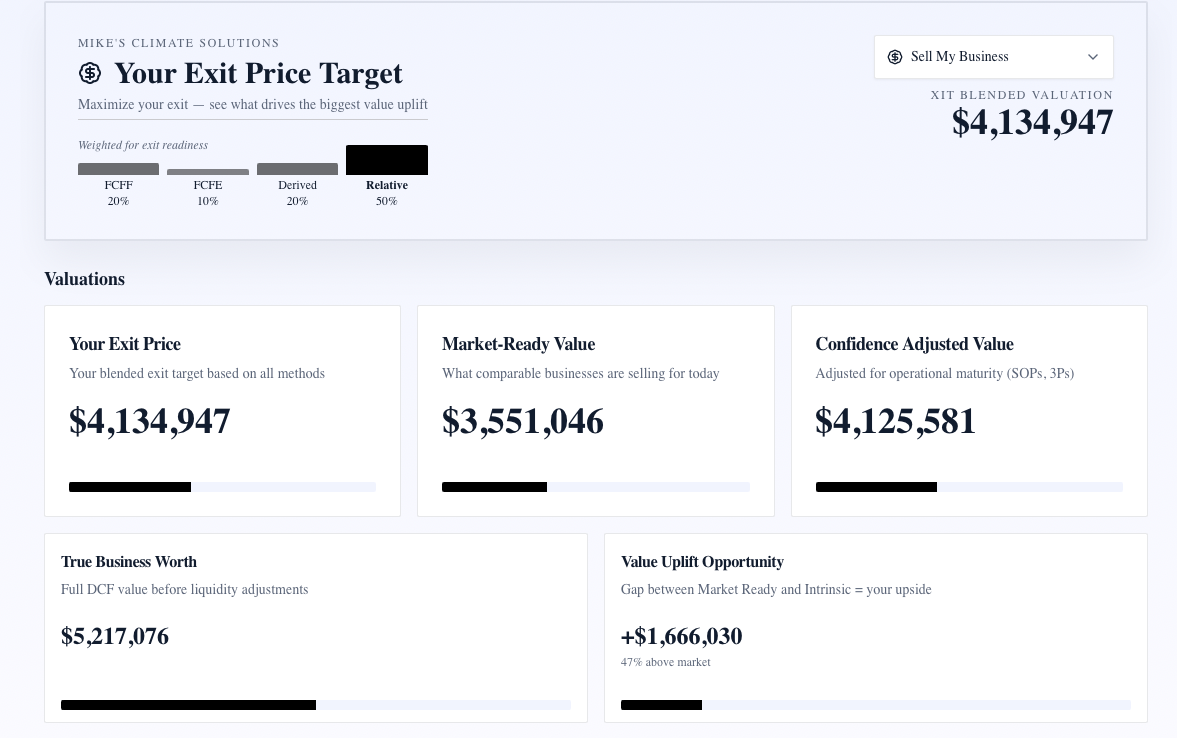
A persona-aware blend. A seller, buyer, capital raiser, and investor each weight the three methods differently, because the right question is different. A seller cares about EV/EBITDA more than DCF — that is what a buyer will pay. A capital raiser cares about FCFE — that is what their shares are worth. The best tool encodes those weightings so the blended answer matches the decision in front of you.
Living, not static. Your business changes weekly. The day a static valuation arrives, it is already partly out of date. The right tool recalculates the moment your numbers change and the moment you move a slider. Watching the valuation move in real time is what teaches you which levers actually matter.
A WACC that respects your capital structure. Many calculators apply a fixed 12 percent discount rate. That is a guess, not a calculation. Your real cost of capital depends on your industry-calibrated unlevered beta relevered to your debt-to-equity, your effective tax rate, and your credit spread. A tool that lets you move those four levers and watch FCFF respond is a tool that respects how PE actually models.
A scenario engine, not a frozen photograph. "What if I raise prices 8 percent? What if I hire two more reps at $80K? What if I retire and replace myself at FMV?" Those are the questions on every owner’s mind. The best tool answers them by translating plain English into exact slider deltas and showing the dollar impact across all three methods.
An illiquidity discount that is not magical. SMB equity is not tradable on a public exchange. Pretending otherwise inflates intrinsic-value estimates by 20 to 40 percent. A defensible tool applies an illiquidity discount and lets you see the gross and net answers side by side.
How XIT Matters scores on each of these axes
XIT Matters was built explicitly around the Exit Matters book methodology, so it implements all of the above by design.
- The blended XIT Valuation weights FCFF, FCFE, derived EV/EBITDA, and the relative-comp answer using persona-specific weights. Switching personas changes the headline number and the supporting tiles in real time.
- A first-pass valuation takes about ten minutes from QuickBooks or Xero connect, or about fifteen with manual input.
- The cost-of-capital simulator exposes credit spread, beta, debt paydown, and effective tax rate as four independent sliders, with industry benchmarks shown alongside.
- The AI Scenario Analyst translates plain-English what-ifs into exact lever moves, returns the dollar impact across every method, and explains which inputs moved and why.
- A configurable illiquidity discount is applied by default and is exposed as a slider so users can stress-test their own assumption.
A worked example
Imagine a $2.5M revenue services business with $500K of EBITDA. A generic online calculator stops at $2.5M (4.5 times EBITDA) and calls the job done. Run the same business through XIT Matters and the picture changes:
- FCFF intrinsic value (11.5 percent WACC, 25 percent illiquidity discount): about $5.2M.
- FCFE equity value (11.5 percent cost of equity, $300K of debt outstanding): about $4.9M to the owner after debt service.
- EV/EBITDA market comps at the median multiple of 3.8 for professional services: $2.0M; at the premium of 5.0 it is $2.7M.
- Blended for a seller persona (more weight on relative): about $4.1M to $4.3M.
- Blended for a capital raiser persona (more weight on FCFE): about $4.5M.
The owner now has a defensible $2.6M to $3.5M range with the qualitative factors that move the multiple — clean financials, recurring revenue mix, owner dependence — visible alongside it. That is a different conversation than "the calculator said $3.5M."
What to do with the answer
A range does more for you than a number. With a defensible range:
- You can negotiate. When a buyer opens at $2.5M, you anchor at $3.5M with the math behind it.
- You can prioritize. If the gap between FCFF and EV/EBITDA is large, that gap is your operational uplift opportunity — improvements in financial cleanliness, recurring revenue percentage, or owner dependence convert it directly into multiple expansion.
- You can plan capital. FCFE tells you what dilution costs you in dollars before you sign a term sheet.
- You can avoid surprises. Watching the methods recalculate as new data lands prevents the "year-end shock" where you discover a six-figure swing only at exit time.
When a tool is not enough
Use the best business valuation tool for small business owners as a compass, not as a contract. For binding events — a sale, a recap, a partner buyout, a divorce, an estate settlement — a CPA-led Quality of Earnings or formal appraisal is still the right document. The tool gets you to that meeting prepared. It does not replace it.
If the tool you choose makes binding promises (an "official appraisal" for $99), walk away. No software can deliver that, and the FTC notices.
How to evaluate any business valuation tool in ten minutes
Before you commit to a platform, run the same sanity check on your own books. Connect or enter two years of P&L and a balance sheet. Confirm the output shows three distinct methods — not one revenue multiple dressed up as three numbers. Move the industry multiple slider and verify EV/EBITDA responds while FCFF and FCFE stay tied to your cash-flow inputs. Switch personas and confirm the blended headline shifts in the direction the book describes (more market weight for sellers, more equity weight for capital raisers).
Ask one plain-English scenario question. If the tool cannot translate it into lever moves and dollar impacts across methods, it is a calculator with marketing copy, not an analyst. Finally, change a single input — growth rate, debt balance, or owner compensation normalization — and confirm every tile recalculates without a manual refresh. Living valuation is the difference between a decision tool and a PDF factory.
Owners who run this ten-minute evaluation rarely go back to single-multiple widgets. The range you get from triangulation is the range you can defend when a buyer, banker, or partner pushes back.
Pair the tool with a simple quarterly ritual: update financials, re-run the blended view, log what moved, and pick one operational lever to test in the AI Scenario Analyst. Over a year that rhythm compounds into institutional fluency — you stop guessing what your business is worth and start managing toward a number you can explain line by line. That is the standard the best business valuation tool for small business owners should enable, and it is the standard XIT Matters was built to meet.
Document the persona you used for each quarterly run. Sellers overweight market comps; capital raisers overweight FCFE; active operators overweight intrinsic cash flow. Keeping that log teaches you how the same business answers different questions — exactly the fluency Chapter 7 describes as the Blended View in practice. After four quarters you will read a buyer's LOI the way a CFO reads a term sheet: calmly, with the range already in hand. That composure is worth more than any single multiple guess. The best business valuation tool for small business owners is not the one with the flashiest marketing — it is the one you will actually open every quarter because it tells the truth about your range and the levers behind it.
Final answer: which tool earns the title
The best business valuation tool for small business owners in 2026 is the one that runs all three institutional methods, blends them for your perspective, exposes the cost-of-capital math, lets you model scenarios in plain English, refreshes as your business does, and stays honest about what it is and is not. XIT Matters is the platform we built to that brief, and it is free during the public beta.
Run your numbers in the next ten minutes. The tool will show you a range and the levers behind it. The decision after that is yours.