Why agency owners need the best exit valuation tool before buyers call
If you are searching for the best exit valuation tool for agency owners, you built a business on client relationships, creative output, and often your own reputation as rainmaker. Buyers underwrite digital agencies differently than product companies — retainer mix, owner dependency, client concentration, and delivery bench depth determine whether you clear the 4.0× median or compress toward 2.5× on normalized EBITDA. The best exit valuation tool for agency owners weights EV/EBITDA for seller conversations, keeps FCFF and FCFE visible for range and walk-away math, and lets you model earn-outs before you sign an LOI.
Exit Matters Chapter 11 treats negotiation as a data sport — sellers who understand value drivers shift leverage. Chapter 7 explains persona-weighted blending: sellers over-weight market comps because acquirers speak EV/EBITDA. Chapter 12 frames exit timing as readiness measurable in multiple movement, not calendar age. Agency owners who prep with three-method data negotiate from strength; those who discover discount drivers in diligence negotiate from surprise.
The digital agency exit multiple band — where your firm sits
Agencies in the typical SMB band ($1M to $15M revenue) trade on trailing EBITDA × industry comps.
Low (2.5× EBITDA) — project-based revenue, owner is rainmaker and creative lead, single-vertical client mix, no retainers.
Median (4.0× EBITDA) — mixed retainers and projects, senior team handles delivery without owner on every account, diversified client base.
High (6.5× EBITDA) — productized service offerings, recurring retainer revenue above 60 percent, senior team less than 60 percent owner-dependent, category specialization (e.g., performance marketing for D2C).
Premium drivers: productized service offering, recurring retainer revenue above 60 percent, senior team less than 60 percent owner-dependent. Discount drivers: project-based revenue with no retainers, owner is rainmaker, single-vertical client mix. Agencies with productized retainers and category specialization trade highest.
Three lenses every agency seller should run before go-to-market
EV/EBITDA — buyer anchor. Normalized EBITDA × position on the 2.5×–6.5× band. Buyers adjust for concentration, churn, and key-person risk. Your exit tool should show band position and drivers before they apply discounts privately.
FCFF — intrinsic floor. Cash the operations generate on first principles. When FCFF sits below the market answer, you may be overpriced relative to cash generation — vulnerability in negotiation.
FCFE — walk-away reality. After debt, transaction costs, taxes, and seller notes. Agency owners who stop at enterprise value routinely overestimate the check.
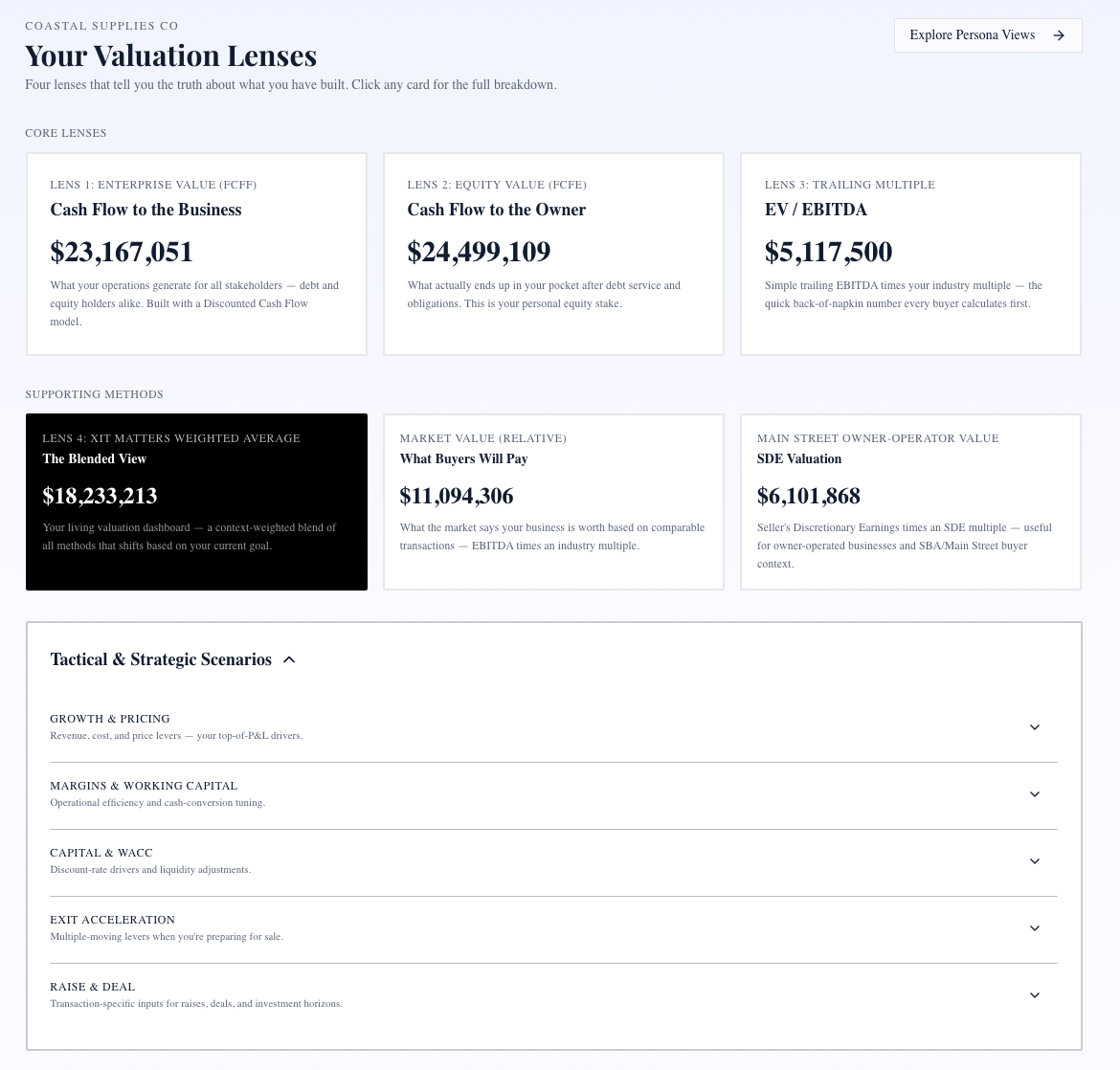
Seller-weighted Blended View produces one headline for LOI conversations while tiles keep all three lenses for counter-arguments.
Pre-exit agency fixes the best tool should quantify
Retainer conversion. Move project clients to monthly retainers where scope allows. Model percentage shifts and multiple expansion.
Rainmaker transition. Hire or promote account and delivery leaders; document playbooks. Reduce owner billable and sales hours.
Client concentration. Cap any single client below 15 percent of revenue before listing.
Productized offerings. Package repeatable services — audits, retainers, managed channels — with defined scope and margin.
Financial normalization. Clean owner compensation, separate personal expenses, auditable time tracking.
Rank fixes by blended delta per dollar invested — that list is your eighteen-month exit prep roadmap.
How XIT Matters serves agency owners planning exit
Select agency industry to load 2.5×–6.5× band with premium and discount drivers. Typical revenue range $1M–$15M.
Activate seller or agency-owner persona for exit-weighted blending. Connect QuickBooks or Xero compatible data or enter financials manually in ten minutes.
AI Scenario Analyst models agency exit questions: earn-out structures, seller notes, working-capital pegs, retainer conversion timelines.
Real-Time Slider Modeling drags owner-dependency, retainer mix, and customer concentration — watch EV/EBITDA and FCFE move together.
Six Persona Views include seller and buyer — rehearse buyer underwrite before negotiation.
EV/EBITDA Market Comps anchor to SMB transaction multiples PE and strategics use in agency roll-ups.
Approved features map to sell-side prep without claims outside the approved grid.
Eighteen-month agency exit prep playbook
Months 1–6: Baseline valuation; fix largest discount drivers — usually rainmaker dependency and concentration. Begin retainer conversion on top accounts.
Months 7–12: Normalize books; build delivery bench; document SOPs. Re-run quarterly; compare to "market-ready" scenario.
Months 13–18: Engage broker if desired; walk in with three-method range, improvement scenario, FCFE walk-away. Use AI Scenario Analyst during LOI for structure stress-tests.
Never share a number you have not normalized. Buyers respect agency owners who understand the math.
Negotiation tactics for agency sellers with three-method data
Counter low anchors with specific drivers: retainer mix, concentration, delivery bench — position on the comp band with evidence.
Model earn-out probability-weighted FCFE — headline EV may net less than lower all-cash offer.
Pre-model working-capital pegs common in agency deals — receivables and WIP adjustments surprise unprepared sellers.
Switch to buyer persona monthly during prep — note which tiles move headline down; fix those first.
Common agency exit valuation mistakes
Waiting until burnout forces sale — urgency compresses multiples.
Sharing EV without FCFE walk-away — LOI number rarely equals deposit.
Ignoring retainer mix — project shops trade as discounts even when revenue looks strong.
Using stale broker estimate from twelve months ago — living tool beats static report.
Skipping normalization — diligence rebuilds EBITDA; surprises kill deals or cut price.
Due diligence prep — what your exit valuation tool should surface first
Sophisticated agency acquirers request client concentration schedules, retainer versus project revenue breakdowns, employee utilization rates, and creative versus account management margin splits before they name a price. The best exit valuation tool for agency owners mirrors that diligence on your side of the table first. Run owner-compensation normalization until FCFE and EV/EBITDA tell a consistent story. Slider client concentration from today's reality to a diversified target and save both scenarios — the delta is your pre-market improvement budget.
Document every adjustment the tool flags as low-confidence. Those flags become your CPA's diligence checklist, not surprises that kill the deal in week three. Export scenario snapshots for your M&A advisor so everyone works from the same three-method baseline instead of conflicting spreadsheets.
Agency deals often include working-capital pegs tied to receivables and work-in-progress. Model those pegs before LOI — a $200K closing adjustment you did not forecast can erase the earn-out upside you negotiated. The AI Scenario Analyst lets you stress-test peg scenarios alongside earn-out and seller-note structures in one session.
Category specialization and why it moves agency exit multiples
Agencies with narrow category focus — performance marketing for D2C brands, healthcare compliance creative, B2B SaaS demand gen — often trade above generalist shops because buyers can underwrite repeatable playbooks. If your firm serves a vertical with active roll-up activity, your median multiple may sit above the generic agency band center. The tool's industry notes reflect that dynamic; use scenario planning to show how deepening specialization affects both EV/EBITDA and FCFF when you pitch strategic acquirers.
Productized service offerings — fixed-fee audits, managed media retainers, creative subscription packages — signal margin predictability buyers reward. Model converting three largest project clients to productized retainers and quantify multiple expansion before you hire a broker. That scenario often convinces owners to invest in sales process change earlier than they would from gut feel alone.
Building a quarterly exit valuation rhythm
Treat exit prep as quarterly re-runs, not a one-time exercise. Month one: baseline. Month three: post-retainer-conversion scenario. Month six: post-hire scenario reducing rainmaker hours. Month nine: buyer-persona rehearsal. Month twelve: seller-weighted headline for advisor conversations. Each checkpoint produces a saved snapshot — when LOI arrives, you show improvement trajectory with data, not narrative.
Agency owners who maintain this rhythm report shorter diligence cycles because buyers encounter fewer surprise discount drivers. You already fixed concentration and key-person issues they would have used as leverage — the best exit valuation tool for agency owners earns its keep in those saved quarters of prep, not just the final LOI spreadsheet.
Earn-out and seller-note structures agency sellers must model
Earn-outs tie part of purchase price to post-close performance — common when buyer and seller disagree on forward revenue or retention. For agency owners, earn-out metrics often include client retention, revenue run-rate, or gross margin on retained accounts. Model probability-weighted outcomes: if 25 percent of price is earn-out and you assign 60 percent probability of full payout, expected FCFE differs materially from headline EV. The AI Scenario Analyst stress-tests these structures before you counter an LOI.
Seller notes defer part of purchase price with interest over three to seven years. You carry buyer credit risk after close — if the buyer struggles post-acquisition, your note may not perform. Run FCFE under full note repayment and under partial default scenarios. A slightly lower all-cash offer may beat a higher EV offer with heavy seller financing when risk-adjusted FCFE is the decision metric.
Asset versus stock sale treatment affects taxes and walk-away — agency owners with S-corps or LLCs should model both with their CPA inputs in mind. The exit valuation tool keeps EV/EBITDA and FCFE visible while you explore structure; tax detail still requires professional advice, but you enter that conversation knowing your range.
When agency owners still need formal appraisal or QOE
Binding events — litigation, divorce, IRS, SBA lender at close, adversarial partner buyouts — require signed opinions. Self-served exit valuation accelerates prep and prevents lowball acceptance but is not the binding artifact at signing. Budget QOE when LOI is signed and deal is real.
Strategic versus financial buyers — model both before you choose
Strategic acquirers — larger agencies, holding companies, private equity platforms rolling up digital services — may pay synergy premiums when your client roster, geography, or capability fills a gap in their portfolio. Financial buyers — search funds, independent sponsors, individual acquirers — anchor strictly to normalized EBITDA on your band with key-person and concentration discounts applied. The best exit valuation tool for agency owners lets you rehearse both conversations from the same baseline.
Run seller-weighted EV/EBITDA for the financial buyer opening bid. Then model strategic uplift as a scenario — not fantasy, but documented synergy such as cross-sell to parent accounts or overhead reduction on shared back office. Compare FCFE under each path after structure. Some agency owners discover the strategic conversation is worth pursuing only when walk-away math beats a financial buyer's all-cash offer with earn-out risk attached. Re-run both scenarios quarterly as retainer mix and rainmaker hours improve — buyer type preference may shift as your profile moves up the band. The best exit valuation tool for agency owners keeps both buyer paths visible so you choose outreach strategy from math, not habit.
The bottom line for agency owners
The best exit valuation tool for agency owners combines digital agency multiples (2.5×–6.5× EBITDA), seller-weighted three-method blending, exit structure scenario modeling, and quarterly re-runs that measure prep ROI in dollars. XIT Matters delivers that workflow free during beta — ten minutes to first range, unlimited AI scenarios, retainer and rainmaker sliders tied to premium drivers. Know your seller-weighted number before the acquirer names theirs. Negotiate from data, not hope.