Valuation calculator for fitness studios — why gym-era multiples misprice boutique cash flow
If you need a valuation calculator for fitness studios, a revenue × 2.5 shortcut from a broker flyer will misprice your studio before you finish exporting Mindbody membership reports. Fitness businesses trade on normalized EBITDA within a rational band — low 2.0×, median 3.0×, high 4.5× for typical Main-Street to lower-middle-market deals in the $500K–$8M revenue range — and your position within that band depends on factors generic calculators ignore: recurring membership base above 70%, multi-location unit economics, hybrid or digital revenue that survives a lease, and whether the brand walks out the door when the founder stops teaching.
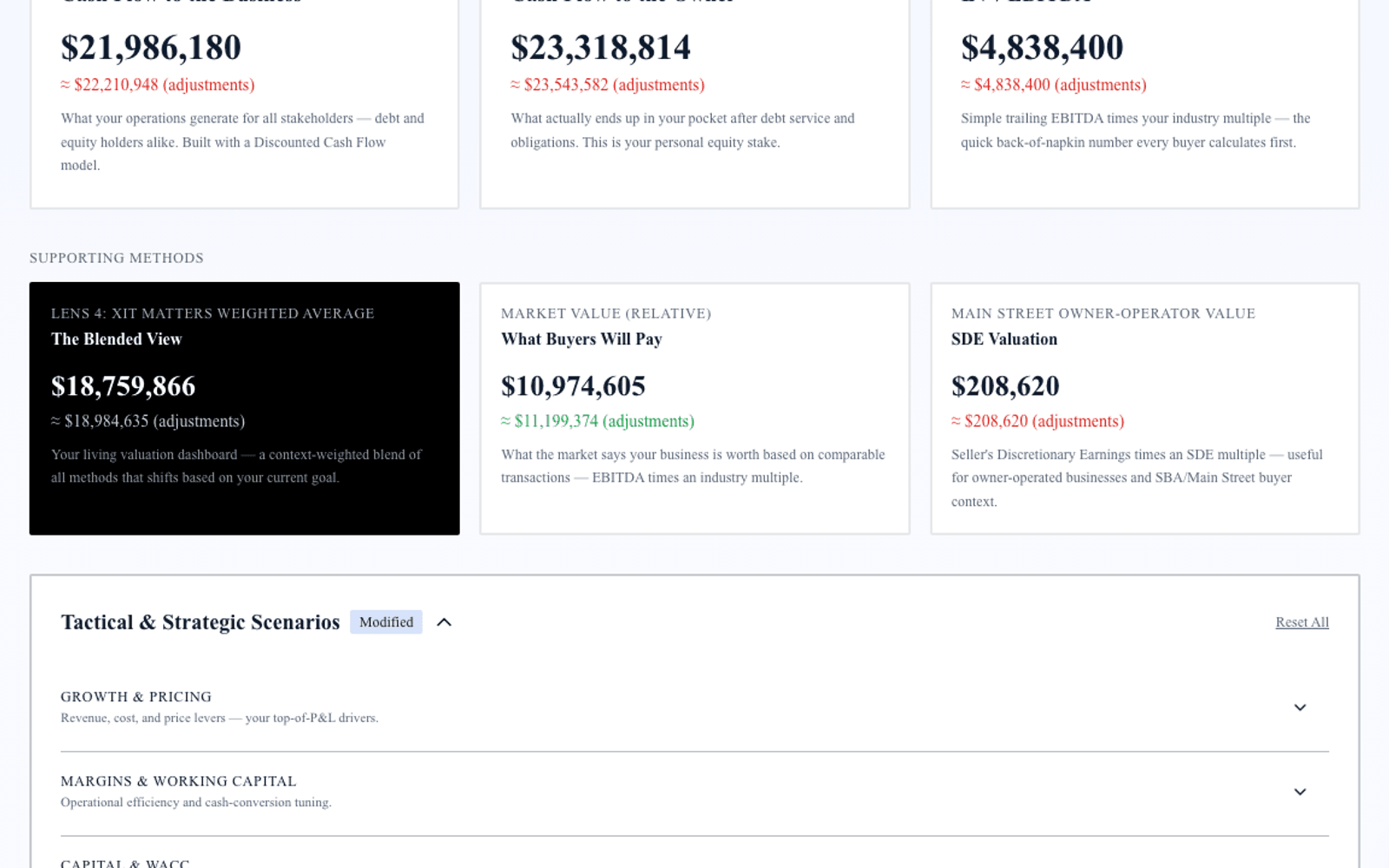
Exit Matters Chapter 7 frames the Blended View — three institutional methods weighted toward your decision. Chapter 9 covers tactical levers — pricing, mix, labor, and lease structure — that move earnings quality before a multiple ever applies. A valuation calculator for fitness studios must run FCFF, FCFE, and EV/EBITDA on normalized financials and expose those fitness-specific drivers. Boutique fitness multi-units (yoga, pilates, F45-style) trade higher than traditional gyms; your calculator should reflect that spread, not bury it in a commodity gym average.
Membership growth recovered through 2024–25; 2026 buyers underwrite retention and recurring mix harder than vanity class utilization. Your calculator should reflect that underwriting shift.
The 2026 fitness multiple band — 2.0× to 4.5× on normalized EBITDA
Current SMB fitness transaction data clusters into a band most studio owners never see until a letter of intent arrives.
Low end (2.0×–2.5×). Single-location dependency, personality-driven brand where the founder is the product, heavy class-pack rather than membership revenue, short remaining lease with above-market rent, no documented instructor bench.
Median (3.0×). Recurring membership approaching or above 70% of revenue, clean two-year financials with membership software reconciliation, market-rate rent with three-plus years remaining, owner transitioning off the floor with documented manager coverage.
High end (3.8×–4.5×). Multi-location operator with proven unit economics, recurring membership base above 70%, strong digital / hybrid offering with measurable retention, diversified instructor roster, and leases that transfer cleanly to a platform buyer.
Two studios at identical EBITDA can sit nearly two turns apart when one is a four-unit pilates platform with hybrid add-ons and the other is a founder-led class-pack studio on a two-year lease.
Why a single multiple is not enough — run three institutional lenses
Free Cash Flow to the Firm (FCFF) projects unlevered cash after maintenance capex on reformers, bikes, flooring, HVAC, and leasehold improvements. Fitness ties cash to build-outs and equipment cycles; deferred maintenance compresses FCFF even when membership dues look stable.
Free Cash Flow to Equity (FCFE) answers what equity holders receive after equipment loans, tenant-improvement financing, and lines of credit. Many studio owners confuse enterprise value with walk-away cash after personal guarantees and remaining lease obligations; FCFE keeps that boundary sharp.
EV/EBITDA anchors to what acquirers and wellness roll-ups pay — the language brokers and PE-backed platforms speak. The multiple adjusts for membership mix, multi-unit proof, hybrid revenue, and owner-as-brand risk.
The Blended View combines the three with weights that shift for reinvestment versus exit. Owner reinvest weighting emphasizes FCFF for a second or third location; seller weighting emphasizes EV/EBITDA for platform and franchise conversations.
Fitness-specific levers the calculator must expose
Membership versus class packs. Enter recurring membership percentage separately from packs, drop-ins, retail, and private training. Shifting twenty points of revenue from packs into auto-renew membership often expands blended value more than a headline price increase on a pack-heavy base.
Owner hours and brand dependency. When the founder teaches signature classes and owns the social following, buyers underwrite key-person risk. Model a hire that cuts owner floor hours from fifty to twenty-eight while holding retention; quantify multiple expansion before you list.
Lease economics. Remaining term, renewal options, CAM, and personal guarantees belong beside the multiple slider. A strong EBITDA year on a lease ending in eighteen months is not a premium story.
Hybrid and digital. On-demand libraries, livestream seats, and app memberships that do not require more square footage support the premium driver of a strong digital / hybrid offering. Enter hybrid as a distinct revenue stream with its own margin.
Multi-unit ramp. Pre-opening losses and immature units distort trailing EBITDA. A valuation calculator for fitness studios should let you normalize to mature-unit economics when modeling platform value.
A worked example — boutique pilates multi-unit, $3.4M revenue
Consider a two-location boutique pilates studio group, $3.4M revenue, $480K normalized EBITDA, 74% recurring membership revenue, 18% class packs and drop-ins, 8% retail and private sessions, founder still teaching twelve classes per week and carrying the brand Instagram, five years remaining on both leases at market rent, nascent hybrid offering at 4% of revenue, equipment loans of $220K outstanding.
A generic calculator might apply 3.0× EBITDA and output $1.44M.
Running three methods: FCFF might land $1.25M–$1.50M after maintenance equipment replacement and working-capital timing on annual membership prepayments. FCFE after equipment debt might sit $1.10M–$1.35M. EV/EBITDA at 2.7×–3.6× given founder-on-floor risk and thin hybrid implies $1.30M–$1.73M. Blended under seller weighting might converge $1.28M–$1.52M — below the naive median print because discount drivers are visible.
The owner sees highest-ROI fixes: grow membership mix above 80%, cut founder floor hours with two lead instructors, push hybrid to 12% of revenue, document unit-level ramp curves for a third location. Each fix is measurable in dollars before a broker process starts.
Chapter 9 tactics apply directly: raise intro-offer discipline so packs convert to membership, renegotiate instructor scheduling to protect margin, and sequence hybrid launch before signing a third lease. The calculator ranks those moves by blended delta instead of gut feel.
Step-by-step — running FCFF, FCFE, and EV/EBITDA on studio financials
Step 1 — Normalize EBITDA. Start with operating income, add back depreciation, then apply fitness-specific adjustments. Add back owner compensation above a market-rate studio or regional manager salary. Remove one-time grand-opening marketing, non-recurring build-out expensed through the P&L, and pre-opening losses on a unit still in ramp. Subtract maintenance capex on reformers, cardio, flooring, and AV required to sustain current member capacity — not discretionary expansion into a new neighborhood.
Step 2 — Build FCFF. Apply effective tax rate to normalized EBITDA after maintenance capex. Add back non-cash charges. Subtract net working capital investment — prepaid annual memberships create deferred revenue that diligence will reconcile; gift-card and pack liability is not free cash. Fitness working capital is often misunderstood as “cash business”; model deferred revenue and instructor payroll timing explicitly.
Step 3 — Derive FCFE. Subtract interest on equipment loans and TI financing after tax. Add net debt issuance only if you are modeling refinance scenarios. Equity walk-away equals enterprise value minus net debt, adjusted for working-capital peg and any assumed rent reset at close.
Step 4 — Anchor EV/EBITDA. Apply the 2.0×–4.5× band position based on membership mix, multi-unit proof, hybrid strength, and owner dependency. At 3.0× median on $480K EBITDA, enterprise value lands at $1.44M before discount drivers adjust placement within the band.
Step 5 — Blend the three. Weight FCFF for second-location decisions, EV/EBITDA for platform buyer conversations, FCFE for personal walk-away after equipment debt. Divergence between methods often reveals deferred revenue misstatement, pack-heavy mix, or lease risk — fix those before opening a data room.
How XIT Matters delivers a fitness studio valuation calculator
XIT Matters ships the fitness band (2.0× low, 3.0× median, 4.5× high) with premium and discount drivers beside the multiple slider — multi-location operator, recurring membership base above 70%, strong digital / hybrid offering on the premium side; single-location dependency, personality-driven brand, and heavy class-pack rather than membership revenue on the discount side.
The Blended Valuation Engine runs FCFF, FCFE, and EV/EBITDA into one answer so you stop guessing which single method to believe.
Real-Time Slider Modeling adjusts recurring membership percentage, owner hours on the floor, hybrid revenue share, and growth visibility — every move recalculates all three methods and the blended headline.
Six Persona Views switch between owner reinvest weighting (second studio, hybrid build) and seller pre-market weighting (roll-up and franchise conversations).
The AI Scenario Analyst accepts plain-English questions such as: “What if membership mix rises to 85% and I cut my teaching to twenty-eight hours a week?” — mapping mix, key-person risk, and multiple together.
Cost of Capital Simulator exposes WACC so equipment refinance or lease-versus-buy decisions flow through FCFF.
EV/EBITDA Market Comps keep you anchored to the same SMB transaction language brokers and PE use.
QuickBooks or Xero compatible entry or manual financials in about ten minutes. Free during beta. Built from Exit Matters methodology — the same institutional lenses PE firms use, translated for studio operators.
Preparing fitness studio financials before you calculate
Gather two years of P&L with membership, pack, private, retail, and hybrid lines separated; balance sheet with equipment schedule and deferred revenue; trailing cash flow; lease abstracts with remaining term, options, and guarantees; membership software export showing active members, monthly churn, and average tenure. Normalize owner compensation, remove one-time openings, write down obsolete retail inventory, and document instructor coverage plans before you trust any headline number.
When a fitness valuation calculator is enough — and when it is not
Use the calculator for sale preparation, partnership buyouts, SBA anchoring, franchise or platform conversations, and ranking membership versus hybrid versus multi-unit investments. Budget formal appraisal or Quality of Earnings for signed LOI diligence, litigation, estate contexts, or franchisor-required ownership transfers. A calculator anchors the conversation; it does not replace QoE when buyers rebuild earnings line by line.
Increasing studio value before you sell
Fix pack-heavy mix and owner-as-brand dependency first, then strengthen hybrid and document multi-unit economics. Model each fix; rank by blended delta. Eighteen months of documented membership conversion and instructor depth often moves multiples more than a short-term promo that inflates class count without retention.
Chapter 9 discipline matters: price intro offers to convert, protect contribution margin on private sessions, and avoid signing a third lease until unit two proves mature-margin repeatability. The calculator makes that sequence visible in dollars.
Membership prepayments, deferred revenue, and cash quality
Annual membership prepayments feel like cash today and create deferred revenue tomorrow. A valuation calculator for fitness studios must treat deferred membership liability carefully in FCFF — buyers rebuild cash conversion from membership software, not from a single strong January. Stress-test a scenario where prepaid annuals shift to monthly billing; near-term cash may dip while quality of recurring revenue rises. Running that scenario first prevents surprise price adjustments when diligence reconciles Mindbody to the general ledger.
Lease renewals and personal guarantees — FCFE reality checks
Studios often look highly profitable until rent resets or a personal guarantee surfaces in the purchase agreement. Enter remaining lease years and modeled rent step-ups when interpreting the 2.0×–4.5× band. Above-market rent compresses operating EV; a below-market short lease can reverse into a discount at renewal. FCFE after assumed rent reset is the number that should drive your personal walk-away floor — not enterprise value alone.
Hybrid launch versus third location — ranking capital decisions
Opening a third studio and launching hybrid digital both consume founder attention and cash. Use Real-Time Slider Modeling and the AI Scenario Analyst to compare a $180K build-out with eighteen-month ramp against a $60K hybrid content and app investment that lifts recurring mix without square footage. Boutique operators who already sit near median often find hybrid plus membership conversion outranks a third lease until unit economics are proven — especially when single-location dependency still discounts the platform story.
Owner-as-brand transition plan buyers will underwrite
Personality-driven brands compress multiples until a transition plan is visible. Document lead instructors, class coverage without the founder, social-handle ownership, and a six-month reduction in owner floor hours. Model the reduction in the calculator before LOI so you can show buyers the multiple path from discount to median. Studios that wait until diligence to reveal founder dependency invite re-trade; studios that pre-model the fix negotiate from strength.
When to refresh your fitness studio valuation
Re-run after a membership-mix shift of ten points or more, lease renewal or relocation, hybrid launch, second-location maturity, crossing $2M revenue with positive normalized EBITDA, or a material change in founder teaching load. Quarterly refresh during exit prep keeps broker and platform conversations current.
Platform buyer versus local operator — persona weighting
Local owner-operators underwrite lifestyle cash flow and SDE; PE-backed platforms underwrite EBITDA, membership KPIs, and multi-unit playbooks. Six Persona Views let you switch seller weighting toward EV/EBITDA for platform conversations and FCFE-heavy blends when a local buyer assumes your equipment debt. Same studio, different headline — both defensible when methodology is transparent and membership quality is documented.
Closing note for fitness studio owners
Your studio deserves more than a traditional-gym multiple. Run the fitness band — 2.0× low, 3.0× median, 4.5× high — on normalized EBITDA for the $500K–$8M revenue range that defines most SMB fitness deals. Normalize membership mix, model owner-as-brand and lease risk, rank hybrid and multi-unit fixes by blended delta, and refresh quarterly. Boutique fitness multi-units (yoga, pilates, F45-style) trade higher than traditional gyms when recurring membership, digital strength, and unit economics are proven — and compress hard when packs and personality carry the P&L.
XIT Matters is free during beta, built from Exit Matters methodology, ready in about ten minutes. Start with trailing-twelve-month normalized EBITDA after maintenance equipment capex — buyers do. Tie every slider move to an operational decision you can execute this quarter: convert packs to membership, hire a lead instructor, launch hybrid retention offers, renegotiate lease options. A valuation calculator for fitness studios earns its keep when it ranks those fixes by dollar impact on blended value, not when it prints a single number you cannot defend when membership software and lease abstracts hit the data room.