How to value a manufacturing business — why standard SMB math falls short
Most small-business valuation guides apply a revenue or EBITDA multiple and call it done. For a manufacturer, that shortcut understates the work by half. Asset-heavy operations carry capex obligations that consume cash the income statement ignores, working capital cycles measured in weeks rather than days, and customer concentration risks that compress or expand the enterprise multiple by a full turn. Learning how to value a manufacturing business properly requires normalizing EBITDA down to true free cash flow, running all three institutional methods, and reading the 3.0×–7.0× band against the specific premium and discount drivers that govern manufacturing transactions.
Exit Matters Chapter 7 calls this the Blended View — FCFF, FCFE, and EV/EBITDA weighted toward the decision in front of you. That framework applies to any industry, but manufacturing introduces four complications the generic version glosses over: maintenance capex, working capital intensity, equipment modernity, and supply-chain concentration. Handle those four correctly and the rest of the valuation follows standard cash-flow logic.
The typical manufacturing business that transacts in the SMB market runs $3M–$50M in revenue and produces normalized EBITDA between $300K and $5M. Multiple band position — not raw EBITDA — determines whether an acquirer prices at 3.0× or 7.0×.
Step 1 — Normalize EBITDA for a manufacturing business
EBITDA is the starting point, not the finish line. Manufacturing-specific normalization adds and subtracts items the standard P&L obscures.
Add back to get to gross normalized EBITDA:
Owner compensation above or below a market-rate plant or general manager. Related-party facility rent above or below arm's-length lease rates — common when the owner holds the building in a separate LLC. One-time tooling, certification, or qualification costs that will not recur. Non-recurring legal, environmental remediation, or equipment repair spikes. Depreciation and amortization (standard add-back for all businesses).
Subtract to arrive at net normalized EBITDA:
Maintenance capex — the recurring annual spend required to maintain current productive capacity. This is the step that most general calculators skip and most sellers under-estimate. A CNC machining center requires rebuilt spindles; a stamping operation replaces dies; a plastics plant cycles molds. If $180K of your reported $900K EBITDA disappears every year into maintenance, your true cash EBITDA is $720K. Use a three-year average to smooth lumpy replacement schedules.
Normalized taxes. If you operate as an S-Corp passing losses through, re-compute a C-Corp equivalent tax rate for buyer comparability.
The result is Normalized EBITDA after Maintenance Capex — the number from which FCFF calculations properly begin.
Step 2 — FCFF for manufacturers (the enterprise/intrinsic lens)
Free Cash Flow to the Firm measures what your manufacturing operation generates for all capital providers before debt service. The formula:
FCFF = Normalized EBITDA after Maintenance Capex × (1 − effective tax rate) + non-cash charges − net working capital investment − growth capex
Working capital investment in manufacturing is material. Manufacturers tie cash in raw materials, work-in-process, and finished goods while waiting on customer payment terms that can run 45–60 days. Model inventory turns and days sales outstanding together — a manufacturer running DSO of 52 days and eight turns per year has fundamentally different FCFF than one at 38 days DSO and twelve turns, even at identical EBITDA.
Growth capex is discretionary investment above maintenance — new lines, expanded capacity, capability upgrades. Exclude it from the FCFF baseline (it is a choice, not an obligation) but model it separately to show buyers what incremental return on invested capital the expansion generates.
FCFF is discounted at Weighted Average Cost of Capital. Manufacturers typically carry higher WACC than service businesses due to asset intensity and customer concentration risk. A precision machinist with one OEM at 50 percent of revenue may price illiquidity and concentration together at 16–20 percent cost of capital; a specialty aerospace supplier with multi-year defense contracts and five customers may discount at 11–13 percent. The difference compounds significantly across a five-year projection.
Step 3 — FCFE and equity walk-away
FCFE strips debt service from FCFF to show actual equity cash flow — what you take home after the bank is paid. For manufacturers, this gap is wider than in service businesses because equipment loans, revolving credit lines, and term facilities are larger and longer.
FCFE = FCFF − interest expense × (1 − tax rate) + net debt issuance
In a sale, FCFE directly governs your personal proceeds. Enterprise value from FCFF and EV/EBITDA establishes the top line; subtract net debt (total debt less cash) to reach equity value — what you actually receive at the wire.
A manufacturer with $2.1M enterprise value and $480K in net debt walks away with $1.62M equity — not $2.1M. Sellers who anchor on enterprise value and discover net debt at the closing table are universally surprised. FCFE prevents that surprise.
FCFE also matters for reinvestment decisions before a sale. If the business generates $410K in annual equity free cash flow on $1.8M equity value, that is a 22.8% cash-on-cash return — worth comparing against any capital-allocation alternative before deciding to sell.
Step 4 — EV/EBITDA market anchor for manufacturing
The manufacturing transaction multiple band sits at:
| Position | Multiple |
|---|---|
| Low (discount) | 3.0× |
| Median | 4.5× |
| High (premium) | 7.0× |
EV/EBITDA applies the multiple to Normalized EBITDA — ideally after maintenance capex, though some market comps use gross EBITDA. When using gross EBITDA comps, verify that peer transactions do not add maintenance capex back; mixing gross and net EBITDA across comps introduces systematic error.
Premium placement requires three or more of:
Specialty or regulated end-market exposure — aerospace components, medical device contract manufacturing, defense sub-assemblies, food-grade pharmaceutical packaging. These markets pay premium because switching costs are high and qualifications take years. Long-term supply agreements of three years or more with volume minimums, reducing revenue uncertainty and giving buyers asset-backed cash flow visibility. Modern equipment fleet with remaining useful life of ten-plus years and annual maintenance capex below 8 percent of EBITDA. Customer count of eight or more, with no single customer above 20 percent of revenue. Documented process certifications (ISO 9001, AS9100, IATF 16949) that create defensible competitive moats.
Discount placement results from:
Single large OEM above 40 percent of revenue — the industry's top multiple killer. Aging equipment with a deferred capex backlog that acquirers must fund in years one through three. Tariff-exposed raw material supply chain without domestic sourcing alternatives or hedging arrangements. Owner-led quality, estimating, or customer relationships with no cross-trained management bench. Revenue concentrated in a single end-market with cyclical exposure.
At 4.5× median on $720K normalized EBITDA, enterprise value lands at $3.24M. At 7.0× on the same EBITDA for a premium operator, enterprise value reaches $5.04M. Understanding which band position your business occupies — and which specific premium drivers you are still missing — is the operating roadmap for how to value a manufacturing business and then improve that value before a transaction.
Step 5 — Blended View for manufacturing owners
No single method tells the full story for a manufacturer. FCFF captures intrinsic discounted cash flow but is sensitive to discount rate assumptions that are hard to defend without deal history. EV/EBITDA anchors to market but ignores capital structure and working capital quality. FCFE shows your equity walk-away but depends on accurate debt schedules.
The Blended View from Exit Matters Chapter 7 weights all three toward the decision context:
Operating/reinvestment persona: Higher weight on FCFF and FCFE — cash generation and equity return govern capital allocation.
Preparing to sell: Higher weight on EV/EBITDA — strategic and financial buyers anchor to market comps.
Raising debt capital: FCFF DSCR (debt service coverage ratio) dominates lender conversations; EV/EBITDA provides enterprise leverage context.
Run all three simultaneously. When FCFF and EV/EBITDA converge within 15–20 percent, you have a defensible range. When they diverge by 40 percent or more, the gap reveals a story — usually undervalued working capital, unpriced capex catch-up, or a multiple assumption that does not match actual comparables.
Asset-heavy considerations: the four manufacturing adjustments buyers always make
1. Capex catch-up schedule. Every buyer or their lender builds a year-one-through-five capex model. If you cannot produce a machine age and replacement schedule, buyers build their own — conservatively. Invest two hours in a plant asset list with replacement dates and your multiple position improves before the first LOI.
2. Inventory quality. Slow-moving or obsolete raw material and WIP sits on the balance sheet at cost but trades at zero in diligence. Net working capital pegs in LOIs often claw back $100K–$400K for manufacturing businesses with aging inventory. Cycle count regularly; write down aged stock before sale.
3. Environmental and compliance exposure. Manufacturing operations generate environmental liabilities that service businesses do not. Buyers at LOI typically require environmental assessments; unresolved Phase I or Phase II findings become indemnity carve-outs or price reductions. Proactive environmental review two to three years before sale lets you remediate on your timeline, not a buyer's.
4. Intellectual property and process documentation. Proprietary processes, tooling designs, customer qualification approvals, and production SOPs embedded in institutional knowledge — not documented procedures — create key-man risk that discounts FCFF discount rates and EV/EBITDA multiples. Documenting the IP you already own costs little but is read by buyers as premium-band evidence.
How XIT Matters handles manufacturing valuation
XIT Matters runs the full Blended Valuation Engine — FCFF, FCFE, and EV/EBITDA simultaneously — on your normalized manufacturing financials. The manufacturing industry band (3.0× / 4.5× / 7.0×) is loaded with the specific premium and discount drivers listed above so band position is explicit, not a default guess.
The Cost of Capital Simulator ties your WACC to customer concentration and recurring revenue mix — critical inputs for manufacturing operators where a single OEM dependency can shift the discount rate by three to five percentage points and move enterprise value by $400K or more.
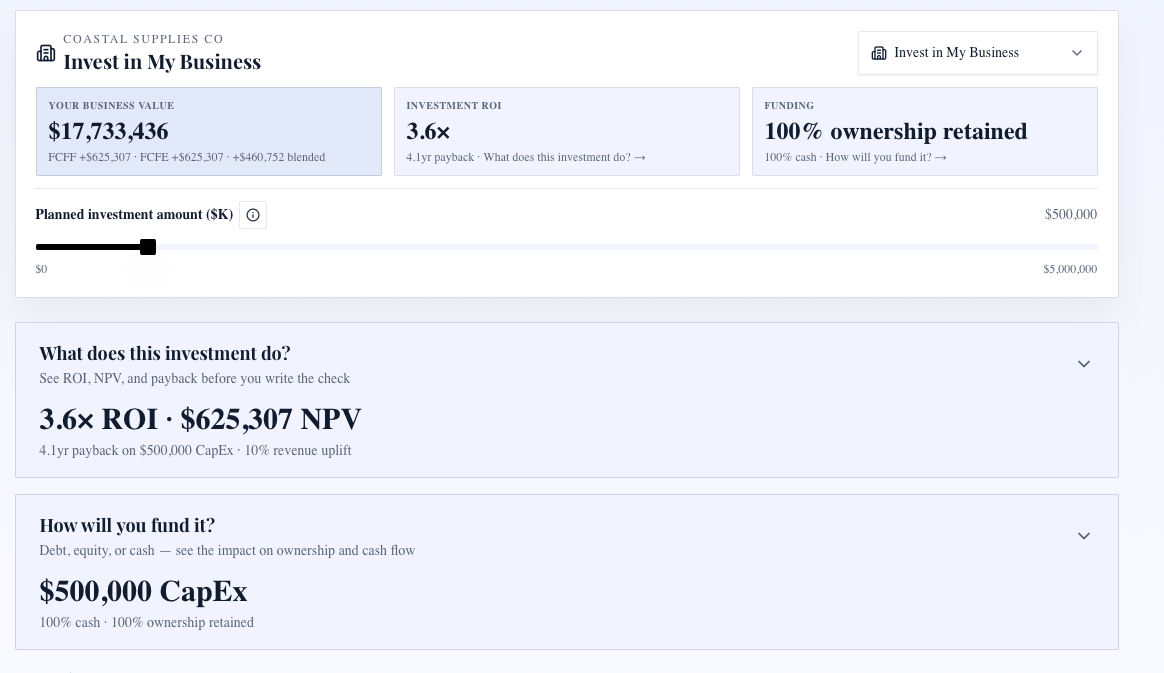
Real-Time Slider Modeling lets you drag maintenance capex, inventory turns, DSO, and customer concentration and watch FCFF, FCFE, and EV/EBITDA recalculate together. Manufacturing owners use sliders to model the capex replacement cycle against the timing of a potential sale — deferring a $180K rebuild one year can swing blended value by more than the equipment is worth.
The AI Scenario Analyst handles compound questions: "What if we win the Tier-1 aerospace contract and add $240K EBITDA while cutting OEM concentration from 52% to 34%?" That question spans revenue, multiple band, WACC, and working capital simultaneously. Slider-by-slider modeling takes an hour; the scenario analyst maps it in a single query.
Six Persona Views cover manufacturing owner operating, seller pre-market, and capital-raiser equity-raise contexts on the same baseline.
QuickBooks and Xero compatible import or manual entry. Free during beta.
Worked example — $8.4M precision machining company
Revenue $8.4M, gross normalized EBITDA $1.1M, maintenance capex $195K per year, net normalized EBITDA after maintenance capex $905K. Net debt (equipment term loans plus line of credit, less cash) $620K.
Three OEM customers represent 38 percent, 22 percent, and 14 percent of revenue. ISO 9001 certified. Fleet age averages six years with a $320K capital expenditure scheduled in year two.
FCFF: $905K × (1 − 27% effective rate) = $661K unlevered net income. Less WC investment $55K. Plus depreciation add-back $195K. FCFF approximately $801K. Discounted at 14.5% WACC (concentration risk, private illiquidity) over five years with terminal value: intrinsic enterprise value $4.2M–$4.8M.
FCFE: FCFF less net interest after tax ($48K) and debt amortization ($120K). Annual FCFE approximately $633K. Equity value at 17% cost of equity: $3.4M–$3.9M enterprise equity before net debt deduction. Subtract $620K net debt: walk-away range $2.8M–$3.3M.
EV/EBITDA: $905K × 4.5× median = $4.1M. At 5.5× (above median — ISO certified, diversified revenue, modern fleet despite year-two capex): $4.98M. At 3.5× (below median — top OEM at 38% adds concentration discount): $3.17M. Seller-weighted blend anchors near $3.8M–$4.4M enterprise value.
Blended range, seller persona: $3.7M–$4.5M enterprise value. Equity walk-away after $620K net debt: $3.1M–$3.9M. The year-two capex creates a $320K negotiating question — a buyer who must fund it within twelve months of close will price it as a discount; a seller who funds it now removes the discount and moves enterprise value above $4.1M.
That is the decision slider modeling answers: spend $320K now and add $500K to blended enterprise value, or sell as-is and absorb the discount.
When to escalate to formal manufacturing appraisal
A blended three-method valuation gives you directional range for operating decisions, capital allocation, and exit preparation. Engage CPA-led Quality of Earnings or formal appraisal for: signed LOI diligence where buyers require audited EBITDA validation; SBA or bank-funded acquisitions requiring certified valuations; partnership buyouts with adversarial parties; estate and gift tax filings; and litigation-related transactions.
The fast institutional baseline gets you to those conversations prepared — EBITDA normalized, capex schedule documented, multiple band position understood — so formal work starts from knowledge instead of blank-sheet discovery.
Bottom line
How to value a manufacturing business in 2026 requires four steps beyond standard SMB math: normalize EBITDA down to true cash flow after maintenance capex, run FCFF and FCFE to expose both enterprise and equity walk-away values, apply the 3.0×–7.0× manufacturing EV/EBITDA band with explicit premium and discount drivers, and blend all three toward your decision context. XIT Matters automates that methodology — manufacturing band pre-loaded, capex slider built in, WACC responsive to concentration — free during beta. Enter your financials in ten minutes, see where you sit on the band today, and model the one or two operational moves that close the gap between discount and median. That clarity is what the buyer on the other side of your future transaction already has. Earn it before the LOI arrives.